
The Intermediate Guide to Mechanics
/When I talk about pitching development, I always come back to one truth: it happens in stages. And one of the most important—and most misunderstood—stages is the intermediate level, especially when it comes to mechanics. Beginners are easy to spot. Advanced pitchers are fun to watch. But intermediate pitchers? That’s where the real work happens. This stage is the bridge between learning mechanics and truly owning them, and how a pitcher moves through this phase often determines her long-term ceiling. For the purpose of this blog, I’m going to focus on mechanical development, not pitch selection or speed—although those things tend to sneak into the conversation anyway.
How I Define Beginner, Intermediate, and Advanced Pitchers
When I think of a beginner pitcher, I’m usually thinking about someone in her first or second year of pitching. At this stage, she’s learning what the mechanics are and what they actually mean. We’re introducing concepts like the takeaway, arm circle, grip, spin, resistance, posture, basic practice habits, how to stand on the mound, how to throw a changeup, and—most importantly—how to pitch without hurting herself. Beginners either don’t know the mechanics yet or can’t perform them consistently. A phrase I hear (and say) a lot at this level is, “When she’s throwing into a net, her mechanics look great—but once she’s in a game, everything falls apart.” That inconsistency is completely normal, even if it doesn’t always feel that way in the moment.
Advanced pitchers, on the other hand, are unconsciously competent. Their mechanics happen automatically because they’ve spent years building strong neural pathways through repetition. At this level, pitchers can focus on performance and very small refinements—things like adding a bit more resistance, improving spin efficiency, or adjusting hip or shoulder angles by fractions of an inch. If I video an advanced pitcher, I constantly see reverse posture, stacked position, a powerful leap off the mound, resistance at landing, and clean, repeatable movement patterns. These are the pitchers who make things look easy, even though we know how much work went into getting there.
Below you can see what “not stacked” looks like versus “stacked.”
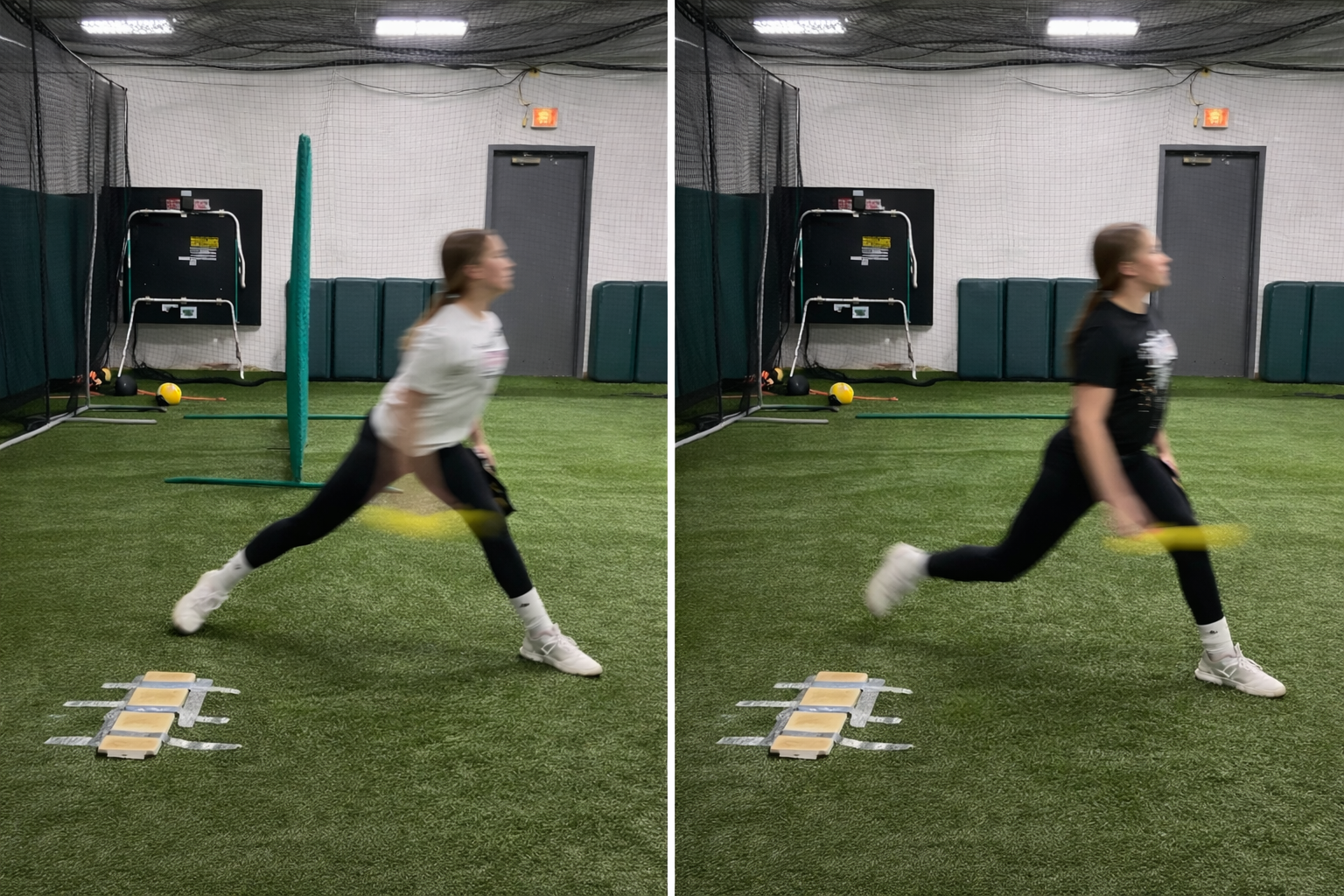
Left: Not Stacked, Right: Stacked
Intermediate pitchers live right in the middle. They understand the mechanics and can often perform them, but not yet consistently or automatically. In our program, I help pitchers identify where they are using our skills assessment and level system. Most intermediate pitchers fall within the red and green zones of our model, while advanced pitchers live solidly in the green zone, with some overlap into purple. Somewhere in that green zone is where an intermediate pitcher begins to transition into advanced—and that’s where things start to get really interesting.
What the Intermediate Stage Is Really About
To me, the intermediate stage is defined by one specific transition: moving from knowing what to do to being able to do it consistently without thinking. Beginners are learning the language of pitching. Advanced pitchers don’t have to think about that language at all anymore. Intermediate pitchers are in the middle, translating what they know into what they can repeat.
At this stage, a pitcher might know how to get into reverse posture, but she can’t do it every pitch. She might leap off the mound sometimes but still step when she’s tired, distracted, or feeling pressure. Resistance shows up on one pitch and disappears on the next. Mechanics still require conscious effort, and pitchers often mentally check in with every part of their delivery instead of letting the sequence flow naturally. The goal here isn’t perfection—it’s consistency.
In practical terms, intermediate pitchers are working to move from throwing pitches to executing pitches. They’re learning how to repeat mechanics as speed, effort, and pressure increase. Progress at this stage often looks quiet: fewer breakdowns, more repeatable deliveries, better control, and growing confidence. It might not always show up immediately on the radar gun, but it absolutely shows up over time.
Why I Prioritize Mechanics Before Movement Pitches
This comes with an important caveat. I teach movement-pitch spins to young pitchers—often as early as fourth or fifth grade—even before their mechanics are even close to being developed. We work on spin and rotation through snaps and from the 9 o’clock position. But being able to spin a ball in a drill and being able to deliver that pitch at full speed in a game are two very different things.
For the purpose of this guide, I’m focusing on mechanics rather than pitch selection. That said, mechanics and movement pitches are inseparable. My goal for an intermediate pitcher is to get her mechanics to a place where she can deliver any movement pitch she wants. If she can’t consistently get into reverse posture, can’t leap effectively, or can’t land with resistance, she’s going to struggle to throw with speed or create real movement. Poor body positioning often forces pitchers into bullet spin, which limits both velocity and movement. I like to think of mechanics as the engine—pitches are just the tools that engine allows you to use.
That said, there are always exceptions. I’ve taught pitchers to throw curveballs to help them understand arm whip and the arm circle before their arm-circle mechanics were fully developed. I know other great coaches in this area who do the same. Pitching development isn’t perfectly linear, and as a coach, I’ll try almost any reasonable way to help a pitcher feel what I’m talking about—even if that means starting with a rise ball in fourth grade if it helps her posture.
How I Help Pitchers Move from Intermediate to Advanced
Moving from intermediate to advanced takes patience, structure, and intention. This isn’t the phase where I want pitchers chasing an advanced pitch arsenal or obsessing over tiny mechanical tweaks. Instead, I want them focused on repetition, sequencing, and building automatic movement patterns. I coach pitchers to prioritize posture, resistance, timing, and arm speed working together as a system. The goal is simple: fewer “good reps only when I think about it” and more “good reps without trying.”
What This Looks Like Over the Course of a Season
Seasonal focus matters. In the offseason, I emphasize slow, intentional mechanical work, drill-based repetitions, and strength and movement development that support posture and resistance. As we move into preseason, we start blending mechanics with more speed and intensity while maintaining quality. During the season, work becomes shorter but stays consistent, focusing on maintenance, feel, and confidence rather than major mechanical changes. The common thread across all seasons is consistency—mechanics don’t magically disappear just because games start.
How Much I Recommend Intermediate Pitchers Practice
At the intermediate level, quality matters more than volume—but volume still matters. I almost always recommend short, focused daily work—often 15 to 30 minutes—over one or two long sessions per week. Over the course of a week, pitchers should have multiple throwing days that balance drill work, full pitching, and recovery. Consistency builds automaticity, and automaticity is what opens the door to advanced pitching.
What I Want Intermediate Pitchers to Focus on Mechanically
When I’m working with intermediate pitchers, I want them focused on repeating reverse posture, leaping off the mound instead of stepping, landing with resistance, and maintaining posture and resistance through release. Those movements need to hold up under fatigue and pressure. This stage is about making foundational mechanics automatic so that speed, movement, and command can eventually take center stage.
The intermediate phase is where real pitchers are built. It isn’t flashy, and it isn’t fast—but it’s powerful. Pitchers who stay patient, commit to the reps, and trust the process during this stage are the ones who eventually develop the strong, repeatable mechanics required at the advanced level.
