
Mental vs. Physical: The Bricks We Carry
/This week at pitching school we taught a mental game that just clicked.
It was built around an analogy. This week, every player drew four large bricks on a piece of paper. Inside each brick they wrote down a pitching mistake they had made. Some wrote “walked a batter.” Others wrote “hit a girl.” Some wrote “threw to the wrong base.” Once the bricks were filled in, we went around the room and asked a simple question: what did you learn from that mistake?
The lesson was this: mistakes are like bricks. If you carry them around, they are heavy. They weigh you down. They are useless. But if you learn from them, you can use them to build something great— a foundation, a wall, even a house. The same brick that drags you down can also build you up.
This is from The Mental Makenings of Champions by Jeff Janssen, M.S., a mental training consultant from the University of Arizona. Coach Tucci was trained using this material in college, and we use it in our summer camps, but this year we decided to go deeper. For twenty weeks — throughout the offseason and preseason — we are working through one chapter at a time.
As we started talking in lessons, I noticed something interesting. When a pitcher threw a wild pitch, I would ask, “What did you learn from that?” They would pause and usually say, “I should concentrate more.” Then they would step back on the mound and try harder. They think that if they just focus enough, they can throw a strike immediately. After all, they’ve thrown strikes before. Why can’t they do it every single time? They did great in practice yesterday. Why not now? They thought their mistake was a mental one.
This lesson reminded me of something I learned in college. There are two kinds of mistakes - physical mistakes and mental mistakes. A physical mistake is a wild pitch, a curveball that doesn’t move, or a ball that goes between your legs. Those are skill-based errors. They require more practice, more reps, more development. They are not moral failures. They are not lacking in caring. On game day, you cannot suddenly control your physical ability beyond the level you have trained. Your body will perform at the level it has been conditioned to perform.
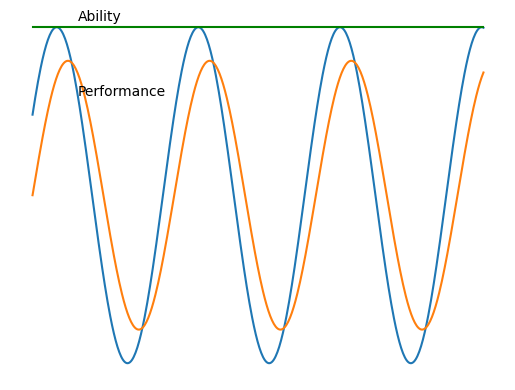
A mental mistake is different. A mental mistake is throwing to the wrong base because you weren’t paying attention. It is forgetting the situation. It is not knowing where the play is. Mental mistakes are about awareness, preparation, and focus — things you can control immediately. You cannot control your physical ability on game day. You can only control your decisions and your focus. I think this chart illustrates physical ability vs. performance perfectly.
When I was in college, I learned that if I made a physical mistake, it meant I needed more practice. If I made a mental mistake, I might be taken out of the game. That distinction changed everything for me. It removed shame from physical growth and placed responsibility where it belonged — on preparation and attention.
Now, there are moments when it isn’t quite that simple. Let’s say a pitcher keeps throwing ground balls and that’s unusual for her. Instead of immediately labeling it one kind of mistake vs. the other, I start asking questions. Where were you looking - at the glove? Did you stay up late the night before? Was the crowd distracting you? If there’s something she can learn from the situation, we work to uncover it together. For example, this situation might require more reps before the next game and making sure to look at a spot on the catcher's glove instead of the general area of the plate. Growth often requires a little investigation and a little experimentation. The goal is to gather information. Because when you understand the “why,” you can build better habits for next time and gather clues on what to practice.
The bricks we carry matter. If a pitcher carries the brick of a wild pitch and tells herself she’s terrible, that brick becomes dead weight. If she asks what she learned and then commits to more reps, that same brick becomes part of her foundation. If she makes a mental mistake and refuses to take responsibility, that brick cracks the structure. But if she owns it and sharpens her awareness, she strengthens it.
Mistakes are not the enemy. Confusion about which kind of mistake was made is the real problem.The goal is not to carry bricks. The goal is to build something with them.
