
How to Teach Pitch Calling Strategy
/In Pitching School, we spend a lot of time helping pitchers simplify their mechanics. The simpler the motion, the easier it is to repeat. The easier it is to repeat, the more strikes they throw and the more spots they hit.
But once a pitcher is able throw strikes, coaches and parents start asking a new question:
"How do I teach pitch-calling strategy?"
It's a great question, and honestly, it's one I have spent a lot of time thinking about.
How I Learned Pitch Calling Strategy
I didn't really learn pitch-calling strategy until college. Even then, I wasn't calling my own pitches.
My pitching coach called nearly every pitch I threw. At first, I simply followed the signs. Over time, I started to notice patterns. Why did she call a rise ball after a changeup? What did she call after a missed location? How did her approach change against stronger hitters versus weaker hitters?
After about a full season, I could predict what pitch she was going to call next.
My catcher learned the same way. By my senior year, we had worked together for so long that she could read my mind. We understood the game the same way because we had learned it together.
The problem is that most youth coaches don't have that luxury.
Teams don't have a dedicated pitching coach. Head and assistants are busy managing lineups, substitutions, defense, and parents. Some teams only have one coach in the dugout.
So how do you teach pitch calling when there isn't someone available to call every pitch?
And even more importantly...
How do you teach strategy to a pitcher who can't consistently hit locations yet?
Is Pitch Calling Too Much for Young Pitchers?
Think about everything we already ask young pitchers to do.
They have to throw strikes and hit spots.
They have to remember mechanics.
They have to throw different pitches.
They have to lead their team.
They have to recover from mistakes.
They have to stay confident.
They have to know where to throw the ball on defense.
They have to block out distractions from opponents.
That's a lot.
Now we want them to analyze hitters, create a plan, adjust during at-bats, and call every pitch too?
Well, if we do, it better be simple.
That's one reason we're adding a pitcher-catcher component to Summer Camp this year. Catchers can see the entire field, communicate with coaches more easily, and help share the responsibility of managing the game. A good catcher can take pressure off the pitcher and help the entire battery work together. My hope is to teach pitchers and catchers learn this together, and have catchers take responsibility to call gaems, but if a team coach prefers, the pitcher should be able to do it as well.
A Simple System: The Sequence Sheet
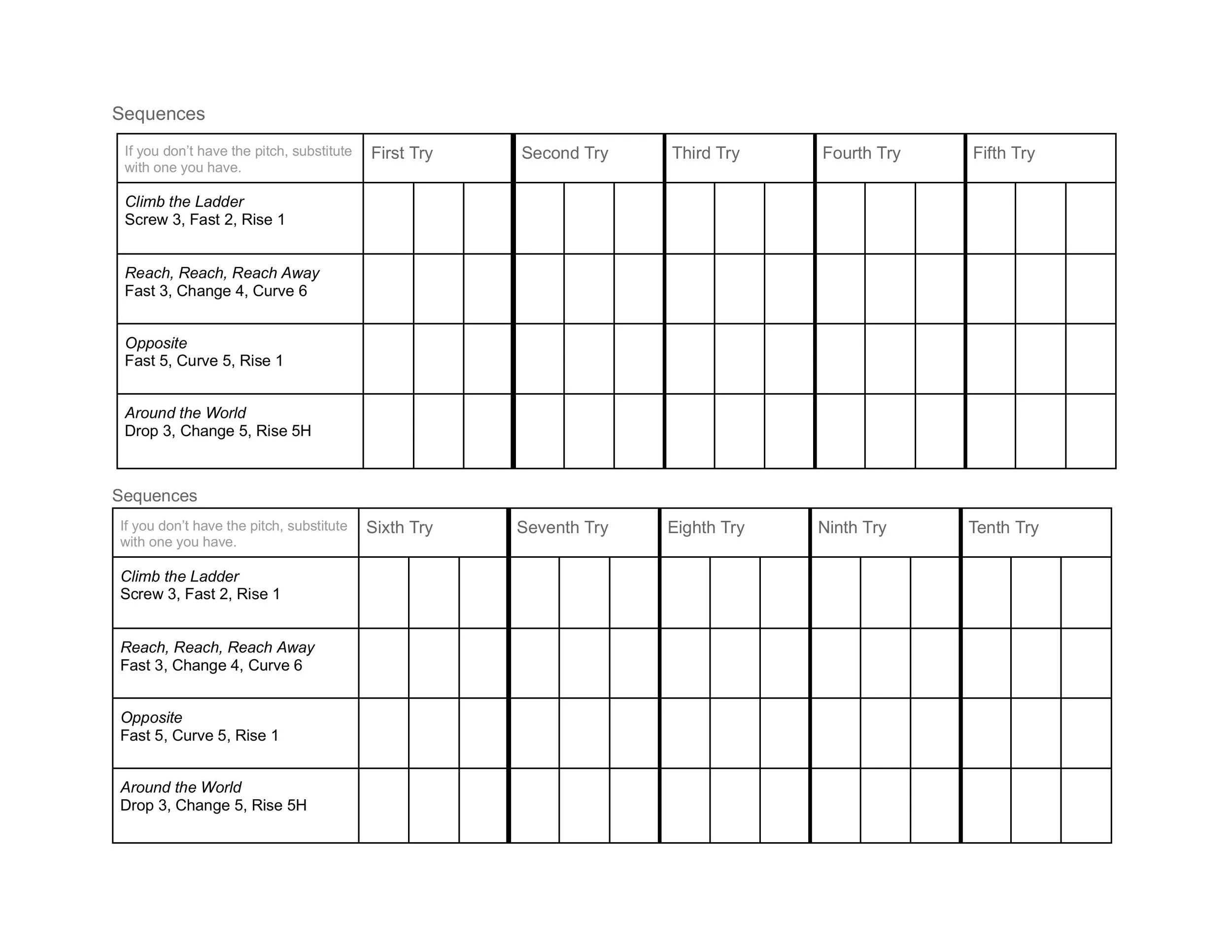
Because coaches kept asking about pitch calling, I started experimenting with a system this in-season called the Sequence Chart.
The idea is simple.
Instead of asking young athletes to invent a game plan from scratch, we give them a few proven sequences to practice.
Each sequence contains three pitch locations.
The goal is to execute all three locations in order.
Just like in a game, the athlete assumes each pitch was a strike and asks:
"What would I throw next to get this hitter out?"
Rather than making hundreds of decisions, they only need to learn a handful of sequences.
Building Strategy One Layer at a Time
I created four sequences, each with a memorable name. Beginners simply choose one and try to execute it. Once they master that, they advance to the next layer.
First, they learn the name of the sequence and which spots apply to it.
Next, after a few games of incorporating different pitches they begin evaluating the batter. Is she crowding the plate? Is she backing off? Which sequence might work best against her?
Then they learn how to adjust when something doesn't go according to plan. What happens if the pitcher misses the first location? Do we stay with the original sequence? Do we repeat the pitch? Do we switch to another sequence entirely?
For example, if the first pitch in a sequence is supposed to be a 3-spot but the pitcher accidentally throws it to the 5-spot, should she continue the original sequence or switch to one that naturally starts with the 5-spot?
Finally, they add movement pitches, if they are at that level. Advanced players can use the movement pitches right from step 1. For example, a 3-spot might be a fastball against one hitter and a screwball against another, but the spot always remains the same in a sequence.
These are the types of decisions that help athletes begin thinking like pitchers and catchers instead of simply throwers and receivers.
Why I Like This Approach
What I like most about the Sequence Sheet is that it provides structure. Instead of throwing young athletes into the deep end of game strategy, it gives them a simple framework they can build on over time.
My guess is that it would take an entire season for most athletes to become comfortable with the system.
The goal isn't to create master strategists overnight.The goal is to gradually teach pitchers and catchers how to think through the game without overwhelming them.
I've included a video explaining exactly how the Sequence Sheet works so Pitching School families can better understand what we're practicing. Here are our spot numbers. Note, we like the players to simply memorize the spots in each sequence, not the type of pitch that goes with it, especially if they don’t know the movement pitch. Pitchers can apply the movement pitches later on in their development.
And if you have another way to teach pitch calling to young players, I'd love to hear it. I'm always looking for ideas that can help athletes learn the game more effectively.
